
For decades, microplastics were treated as an environmental problem. Something found in oceans, soil, and the fish we eat, but not inside us. That assumption ended in 2022, when a team of Dutch researchers reported the first confirmed detection of plastic particles circulating in human blood.
This was not a fringe claim from a blog or a documentary. It was published in Environment International, a peer-reviewed environmental health journal, and it kicked off a wave of follow-up research that is still active today. Here is what the original study actually found, what later research has added, and what realistically helps reduce your exposure.
The Study That Started It
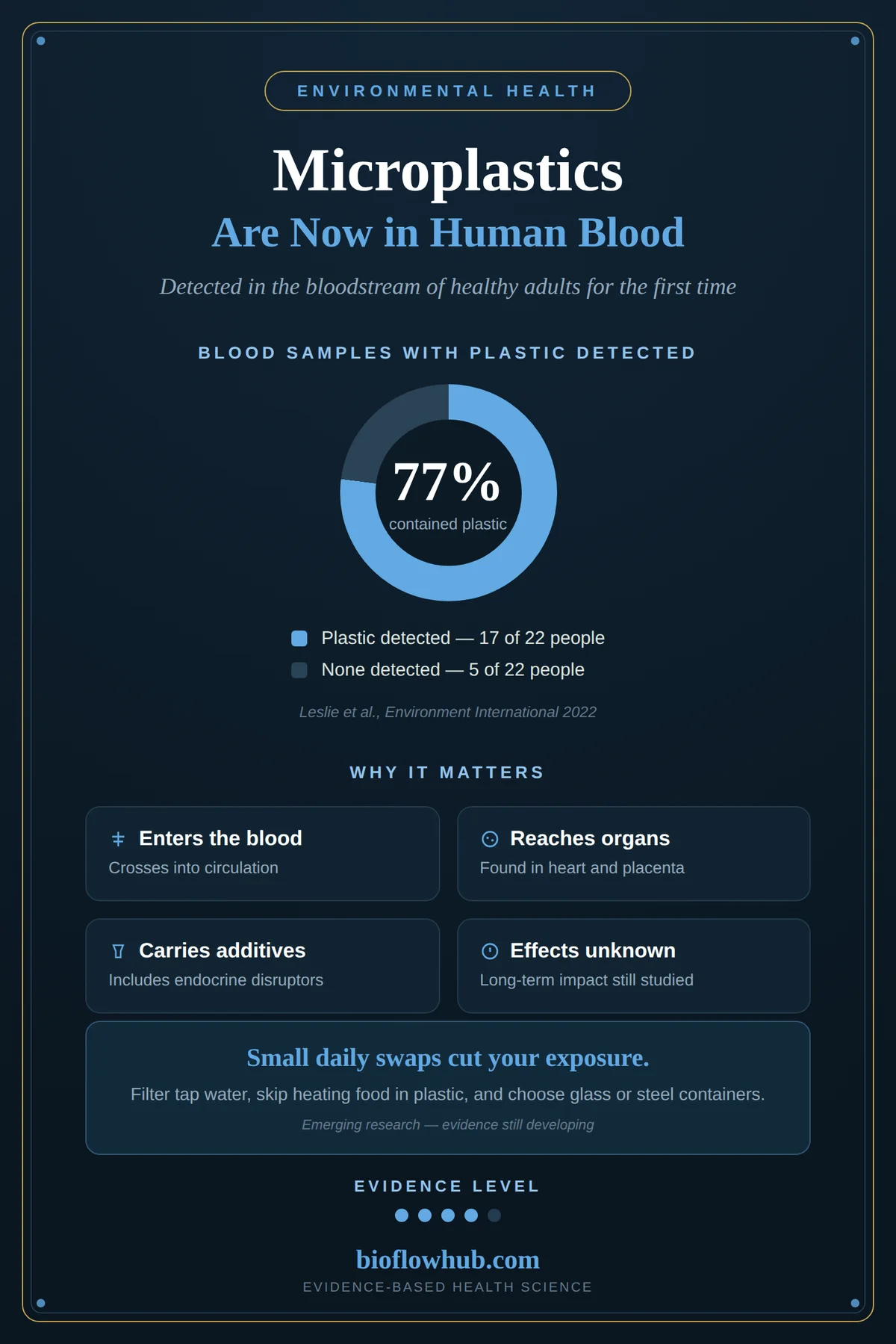
Researchers from VU Amsterdam, Deltares, and Amsterdam UMC analyzed whole blood from 22 anonymous, healthy adult volunteers. Using a validated method built on pyrolysis gas chromatography mass spectrometry, they screened for five high-production plastics: PET, polyethylene, polypropylene, polystyrene, and PMMA.
Quantifiable plastic particles showed up in 17 of the 22 donors, roughly 77 percent. Half of the samples contained PET, the plastic used in disposable drink bottles. More than a third contained polystyrene, common in food packaging. Close to a quarter contained polyethylene, the plastic in most shopping bags.
This was the first study of its kind, and the sample size reflects that. Twenty-two people is a pilot study, not a population-wide claim. What it established is proof of concept: plastic particles can cross from the environment into general human circulation. That single fact opened the door to a much larger research effort.
Does the 77 percent figure hold up? This is worth answering directly, since it is the number everyone quotes. Since 2022, at least three more research groups have tested human blood for microplastics, each with a different method and population:
- In 2024, the same Dutch team published a follow-up study with 68 volunteers and a refined version of their original method, expanding the polymer panel and tightening quality control. They reliably quantified plastic in 17 of 68 samples, 25 percent, a notably lower rate than their first pilot.
- That same year, a UK team using a different detection method (μFTIR instead of pyrolysis-GC/MS) found plastic in 18 of 20 volunteers, 90 percent.
- A South Korean team, also using μFTIR, found plastic in 32 of 36 participants, 88.9 percent.
So the prevalence reported across independent studies ranges from 25 to 90 percent depending on the detection method and the population tested. The 77 percent figure from the original study sits inside that range, but it is not a stable, settled number, and presenting it as the definitive rate overstates what a single 22-person pilot study can establish. What is consistently confirmed across every one of these studies, regardless of method, is the underlying fact: plastic particles are present in human blood. The exact proportion of people affected is still being worked out, and will likely keep shifting as methods improve.
References:
- Leslie HA, et al. (2022). Discovery and quantification of plastic particle pollution in human blood. Environment International, 163, 107199. PubMed
- Brits M, et al. (2024). Quantitation of micro and nanoplastics in human blood by pyrolysis-gas chromatography-mass spectrometry. Microplastics and Nanoplastics, 4, 12. Springer
- Leonard SVL, et al. (2024). Microplastics in human blood: Polymer types, concentrations and characterisation using μFTIR. Environment International, 188, 108751. PubMed
- Lee DW, et al. (2024). Microplastic particles in human blood and their association with coagulation markers. Scientific Reports, 14, 30419. PubMed
Why It Matters Beyond the Bloodstream
Blood does not stay in one place. It reaches every organ in the body, which raised an obvious question: if plastic gets into circulation, where does it end up next? The answer has not been reassuring.
It reaches the placenta. In 2021, a separate Italian research team reported microplastics embedded in human placental tissue, on both the maternal and fetal sides. A later electron microscopy study found the particles inside placental cells themselves, alongside structural changes in mitochondria and other organelles. Whether that damage has real consequences for pregnancy outcomes is still being investigated, but the location alone, a tissue built to protect a developing fetus, is concerning.
It reaches the heart. Patients undergoing cardiac and carotid artery surgery have had microplastics identified directly in their tissue and arterial plaque. The most significant finding so far came from a 2024 study in the New England Journal of Medicine: among 257 patients who had carotid plaque removed, those whose plaque contained microplastics had a meaningfully higher rate of heart attack, stroke, or death over roughly three years of follow-up than those whose plaque did not. This is the strongest human evidence to date linking microplastic presence to an actual clinical outcome, not just exposure.
It is worth noting that this study was also followed by a published critique questioning whether some of the detected particles came from contamination during surgery rather than from the patients themselves. That is a legitimate scientific debate, and it is exactly how good science is supposed to work: a striking result gets scrutinized, not just repeated.
It carries more than just plastic. Plastic particles rarely travel alone. Manufacturing additives, including phthalates and bisphenols that act as endocrine disruptors, can be released from the particles once inside the body. Animal studies have linked microplastic exposure to inflammation and oxidative stress, but how directly that translates to humans is still being worked out.
The long-term effects are still unknown. This is the most honest thing that can be said about this entire field. Detection is ahead of understanding. Researchers can now find microplastics in blood, organs, and tissue with increasing precision, but the question of what sustained, lifelong exposure does to human health has not been answered with the kind of large, controlled, long-term data that would settle it. Treat strong claims in either direction, that it is catastrophic or that it is nothing to worry about, with some skepticism until more evidence accumulates.
References:
- Ragusa A, et al. (2021). Plasticenta: First evidence of microplastics in human placenta. Environment International, 146, 106274. PubMed
- Marfella R, et al. (2024). Microplastics and nanoplastics in atheromas and cardiovascular events. New England Journal of Medicine, 390(10), 900-910. PubMed
- Vethaak AD, Legler J. (2021). Microplastics and human health. Science, 371(6530), 672-674. PubMed
What You Can Actually Do About It
Total avoidance of microplastics is not realistic. They are in tap water, sea salt, the air, and most packaged food. But meaningful reduction is, and a few habits make a measurable difference without requiring you to overhaul your life.
Boil and then filter your tap water. A 2024 study found that boiling tap water causes nano and microplastics to get trapped inside the calcium carbonate that forms as the water heats, the same limescale that builds up in a kettle. Filtering out that residue afterward, even through a simple coffee filter, removed up to 90 percent of the particles in hard water. This is one of the cheapest, most accessible interventions available, since most households already have the tools for it.
Never heat or microwave food in plastic. This is the single highest-leverage change you can make. A 2023 study measured microwave heating releasing as many as 4.22 million microplastic and 2.11 billion nanoplastic particles from just one square centimeter of plastic container surface in three minutes. Refrigeration and long-term storage released measurable amounts too, just far less. Transfer food to glass or ceramic before microwaving, and avoid storing food in plastic for extended periods.
Choose glass or steel over plastic for storage. This matters most for hot liquids, oily or acidic foods, and anything stored long-term, all of which accelerate particle release from plastic surfaces.
Reduce, do not panic. None of this requires anxiety or obsessive avoidance. It requires a few durable swaps in the two highest-exposure areas of daily life: drinking water and food heating. That alone addresses a large share of avoidable exposure.
References:
- Yu Z, et al. (2024). Drinking boiled tap water reduces human intake of nanoplastics and microplastics. Environmental Science & Technology Letters, 11(3), 273-279. ACS Publications
- Hussain KA, et al. (2023). Assessing the release of microplastics and nanoplastics from plastic containers and reusable food pouches: Implications for human health. Environmental Science & Technology, 57(26), 9782-9792. PubMed
The Bottom Line
Microplastics in human blood is not a hypothetical risk anymore. It is a measured fact, confirmed and expanded on by multiple independent research groups since 2022. What remains genuinely uncertain is the scale of harm from chronic, lifelong exposure at the levels most people actually experience.
That uncertainty is not a reason to dismiss the topic, and it is not a reason to panic either. It is a reason to follow the research as it develops, and in the meantime, to reduce exposure where it is easy and cheap to do so. Filtering water and avoiding heating food in plastic will not eliminate microplastics from your life. They will meaningfully reduce how much of it you are adding to it every day.
Have a question or a topic you would like covered? Leave a comment below or get in touch.