
Stress is not inherently bad. The acute stress response is one of the most elegant survival mechanisms in human biology, mobilizing energy, sharpening focus, and preparing the body for action. When you exercise, fast, or face a meaningful deadline, your body activates the same stress response in a controlled and temporary way. Scientists call this positive form “eustress,” and it is one of the primary mechanisms behind the benefits of exercise, cold exposure, and deliberate challenge.
The problem begins when that same system is activated chronically by the pressures of modern life: financial pressure, relationship conflict, work demands, social anxiety. In this case, cortisol and sympathetic activation remain persistently elevated, producing effects that accumulate and damage the body over time.
This cumulative wear has a name in the research literature: allostatic load. The body’s stress systems are built to mobilize quickly and then return to baseline once the threat passes. Allostatic load describes the biological cost of a system that never fully returns to baseline, staying in a low-grade state of activation across cardiovascular, immune, metabolic, and neuroendocrine systems simultaneously.
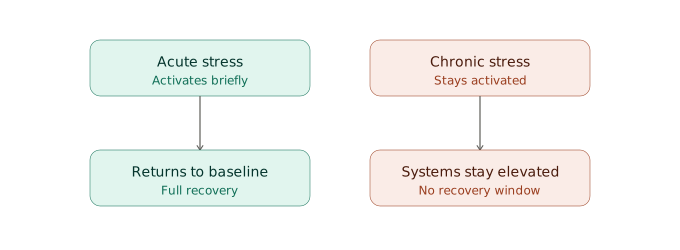
It is not any single elevated hormone level that causes harm. It is the compounding effect of multiple systems running slightly hot for months or years, which is precisely why chronic stress is linked to such a wide and seemingly unrelated range of health problems.
The Physiology of the Stress Response
When your brain perceives a threat, real or imagined, it activates the hypothalamic-pituitary-adrenal (HPA) axis and the sympathetic nervous system. This triggers the release of adrenaline within seconds and cortisol within minutes.
These hormones produce a cascade of effects: heart rate increases, blood flow is redirected to muscles, digestion slows, and glucose is released into the bloodstream for immediate energy. This is the classic fight-or-flight response, and in the short term it is highly adaptive.

What Chronic Stress Does to Your Body

Cardiovascular system. Chronic stress increases blood pressure, promotes arterial inflammation, and accelerates atherosclerosis. A landmark review published in Nature Reviews Cardiology concluded that psychosocial stress plays a significant and independent role in the development and progression of cardiovascular disease, comparable in impact to traditional risk factors like hypertension and elevated LDL.
Immune system. Cortisol is a potent immunosuppressant in the short term. Chronically elevated cortisol disrupts immune regulation, increasing susceptibility to infections and paradoxically also contributing to chronic inflammation through dysregulation of inflammatory signaling pathways.
Brain and mental health. Prolonged stress exposure is associated with structural changes in the brain, including reduced volume in the hippocampus, a region critical for memory and emotional regulation. Chronic stress is a major independent risk factor for anxiety disorders and depression.
Metabolic health. Cortisol promotes fat storage, particularly visceral fat around the abdomen, and impairs insulin sensitivity. Chronic stress is therefore a direct contributing factor to weight gain and type 2 diabetes risk independent of diet and exercise.
Digestive system. The gut and brain communicate continuously through the vagus nerve and a shared population of neurotransmitters, which is why chronic stress so reliably produces digestive symptoms. Sustained cortisol elevation increases intestinal permeability, alters gut motility, and shifts the composition of the gut microbiome toward less favorable bacterial populations. This is the physiological basis for why stress so commonly triggers or worsens irritable bowel syndrome, acid reflux, and general digestive discomfort, and why digestive complaints are frequently among the first physical symptoms people notice during prolonged stressful periods.
Cellular aging. Psychological stress has been associated with accelerated telomere shortening, a marker of cellular aging. A groundbreaking study found that mothers of chronically ill children had significantly shorter telomeres than age-matched controls, suggesting that sustained psychological burden accelerates biological aging at the cellular level.
It is also worth noting that what ancient wisdom traditions have long taught about anger and resentment finds strong support in modern research. Chronic hostility and rumination, the tendency to dwell repeatedly on negative experiences, are independently associated with increased cardiovascular risk, elevated inflammatory markers, and poorer immune function. Letting go, in whatever form that takes for you, turns out to have measurable biological benefits.
Science has increasingly confirmed something many traditions have long understood: having a sense of purpose larger than oneself is not merely a philosophical ideal but a measurable health advantage. Studies consistently show that individuals with a strong sense of purpose have significantly lower all-cause mortality and greater resilience to stress.
References:
- Kivimäki M, Steptoe A. (2018). Effects of stress on the development and progression of cardiovascular disease. Nature Reviews Cardiology, 15(4), 215-229. PubMed
- Epel ES, et al. (2004). Accelerated telomere shortening in response to life stress. PNAS, 101(49), 17312-17315. PubMed
- Gerin W, et al. (2006). The role of angry rumination and distraction in blood pressure recovery from emotional arousal. Psychosomatic Medicine, 68(1), 64-72. PubMed
- Alimujiang A, et al. (2019). Association between life purpose and mortality among US adults older than 50 years. JAMA Network Open, 2(5), e194270. PubMed
💊 Chronic stress depletes magnesium levels significantly. Magnesium Glycinate is one of the most evidence-backed supplements for supporting stress regulation, sleep quality, and nervous system function.
Check Magnesium on Amazon →The Role of Perception in Stress
One of the most important insights from stress research is that the physiological stress response is not triggered solely by objective circumstances but by how those circumstances are perceived and interpreted.
A landmark study followed over 28,000 adults for 8 years and found that people who reported high levels of stress and believed that stress was harmful to their health had a 43% increased risk of premature death. Remarkably, people who reported high stress but did not perceive it as harmful had no increased mortality risk.
This does not mean stress is harmless. It means that how you relate to stress matters enormously, and that psychological interventions aimed at reframing the stress response can have real physiological consequences.
This finding has a theoretical foundation that predates it by decades. Psychologists Richard Lazarus and Susan Folkman proposed in the 1980s that stress is not a direct response to an event itself, but to the cognitive appraisal of that event: whether it is judged as a threat, a manageable challenge, or irrelevant, and whether the person believes they have the resources to cope with it. Two people facing an identical stressor, a tight deadline, a difficult conversation, a health scare, can have entirely different physiological responses depending on this appraisal process. This is part of why generic stress-reduction advice has limited effect for some people: the underlying appraisal, the story being told about the stressor and one’s capacity to handle it, is often the more direct lever than the external circumstance itself.
References:
- Keller A, et al. (2012). Does the perception that stress affects health matter? The association with health and mortality. Health Psychology, 31(5), 677-684. PubMed
Evidence-Based Interventions for Stress Management
Physical exercise is consistently the most well-supported intervention for stress and its downstream effects. Exercise reduces cortisol over time, increases BDNF (a protein that supports brain health and neuroplasticity), and produces lasting improvements in mood and anxiety. Even a single session of moderate aerobic exercise produces measurable reductions in anxiety within hours.
Yoga and Pilates deserve special attention within the exercise category. Unlike conventional aerobic or resistance training, these practices combine physical movement with breath control and present-moment awareness, producing stress-reduction benefits through multiple simultaneous mechanisms. A meta-analysis published in Frontiers in Psychiatry found that yoga significantly reduced perceived stress, anxiety, and cortisol levels across multiple populations. Pilates has demonstrated similar benefits for psychological well-being, particularly in adults dealing with work-related stress. Both practices are accessible, require minimal equipment, and are sustainable long-term, which is one of the most important variables in any stress management strategy.
References:
- Schleinzer A, Moosburner A, Anheyer D, Burgahn L, Cramer H. (2024). Effects of yoga on stress in stressed adults: a systematic review and meta-analysis. Frontiers in Psychiatry, 15, 1437902. PubMed
Mindfulness-based stress reduction (MBSR) is an 8-week structured program that combines meditation, body scanning, and mindful movement. Multiple randomized controlled trials have demonstrated its efficacy in reducing perceived stress, anxiety, and depression, as well as producing measurable changes in cortisol patterns. A systematic review and meta-analysis published in Psychoneuroendocrinology confirmed that mindfulness and relaxation interventions are among the most effective strategies for reducing cortisol levels in healthy adults.
References:
- Rogerson O, Wilding S, Prudenzi A, O’Connor DB. (2024). Effectiveness of stress management interventions to change cortisol levels: a systematic review and meta-analysis. Psychoneuroendocrinology, 159, 106415. PubMed
Prayer and scripture engagement represent an often-overlooked but scientifically supported intervention for stress. Research published in Psychology of Religion and Spirituality has found that reflecting on biblical scripture produces physiologically measurable reductions in cardiovascular stress reactivity among Christian practitioners. A PubMed-indexed study found that reading scripture during stressful life events functioned as a meaningful coping resource, helping individuals maintain hope and emotional stability. For those with a faith practice, these findings are not surprising. What is significant is that the stress-dampening effects are measurable in physiological terms, not just subjective ones.
References:
- Krause N, Pargament KI. (2018). Reading the Bible, stressful life events, and hope: assessing an overlooked coping resource. Journal of Religion and Health, 57(4), 1428-1439. PubMed
Social connection is a powerful buffer against the physiological effects of stress. Strong social relationships are associated with lower cortisol reactivity to stressors, better immune function, and significantly lower mortality risk. The widely cited comparison that social isolation carries health risks comparable to smoking reflects the magnitude of this effect, a finding supported by multiple large epidemiological studies. The mechanisms are direct: chronic loneliness dysregulates the HPA axis, elevates basal cortisol, promotes systemic inflammation, and increases cardiovascular risk independently of other lifestyle factors.
Time in nature has a growing evidence base. Studies using cortisol measurements and heart rate variability have shown that spending time in natural environments, even for relatively short periods, reduces physiological markers of stress compared to urban environments.
Sunlight exposure is underrepresented in most stress management discussions despite having a well-characterized biological mechanism. Sunlight, particularly in the morning, promotes serotonin synthesis in the brain, a neurotransmitter that directly counteracts cortisol’s effects on mood and anxiety. A study published in The Lancet found that serotonin turnover in the brain was directly related to sunlight exposure on the day of measurement, independently of season. Sunlight also supports vitamin D synthesis, and vitamin D deficiency has been independently associated with increased HPA axis reactivity and higher baseline cortisol. Even 15 to 20 minutes of morning sun exposure without sunglasses can meaningfully anchor circadian cortisol patterns, improving both daytime alertness and evening cortisol decline.
Limiting recreational screen time is an intervention supported by growing experimental evidence. A study published in npj Mental Health Research found that reducing recreational digital screen use significantly improved self-reported wellbeing and mood in adults over two weeks. A systematic review and meta-analysis of 37 cross-sectional studies confirmed a significant association between excessive smartphone use and elevated stress, anxiety, and depression. The mechanism involves multiple pathways: constant notifications maintain sympathetic nervous system arousal, social media triggers social comparison responses, and blue light from screens disrupts melatonin and cortisol rhythms when used in the evening. Passive consumption, scrolling without interacting, is particularly associated with worse outcomes than active communication.
Meaningful, disciplined work is a protective factor that tends to be overlooked in stress management conversations. The research on purpose and meaning consistently shows that people who feel their work has significance and direction have significantly better stress resilience and lower cortisol reactivity to challenges. This is not about working more. Excessive work demands are a well-documented stressor. It is about the quality of engagement. Work that feels meaningful, pursued with clear intention and reasonable limits, activates different neurobiological pathways than work experienced as meaningless obligation or chaotic overload. Setting clear boundaries around work hours, taking genuine recovery time, and connecting daily tasks to a larger sense of purpose are not productivity strategies. They are stress physiology interventions.

Diaphragmatic breathing and other slow breathing techniques activate the parasympathetic nervous system through the vagus nerve, producing rapid reductions in heart rate, blood pressure, and subjective anxiety. Techniques involving exhalations longer than inhalations are particularly effective for activating the relaxation response.
References:
- Hofmann SG, et al. (2010). The effect of mindfulness-based therapy on anxiety and depression: a meta-analytic review. Journal of Consulting and Clinical Psychology, 78(2), 169-183. PubMed
- Chu B, et al. (2024). Physiology, Stress Reaction. StatPearls, NCBI Bookshelf. PubMed
- Krause N, Pargament KI. (2018). Reading the Bible, Stressful Life Events, and Hope: Assessing an Overlooked Coping Resource. Journal of Religion and Health, 57(4), 1428-1439. PubMed
- Li H, Xia N. (2020). The role of oxidative stress in cardiovascular disease caused by social isolation and loneliness. Redox Biology, 37, 101585. PubMed
- Pedersen J, et al. (2022). Effects of limiting digital screen use on well-being, mood, and biomarkers of stress in adults. npj Mental Health Research, 1, 14. PubMed
How Quickly Do These Interventions Actually Work
Not all stress interventions operate on the same timescale, and knowing the realistic timeline for each helps set expectations and avoid abandoning something effective too early.
Some effects are nearly immediate. A single session of moderate aerobic exercise measurably reduces anxiety within hours, and slow diaphragmatic breathing can shift heart rate variability within minutes through direct vagal activation. These fast-acting tools are most useful for managing an acute stress spike in the moment, but their effects are also the most transient, typically fading within a day without repetition.
Other interventions require sustained practice before their full effect appears. Mindfulness-based stress reduction is structured as an 8-week program for a reason: meaningful, measurable changes in cortisol patterns and perceived stress generally build over that timeframe rather than appearing in the first week or two. Yoga interventions in the cited meta-analysis showed benefits accumulating across multiple weeks of regular practice, not from a single class. Morning sunlight exposure and screen time reduction occupy a middle ground, with measurable mood and alertness benefits often appearing within days but circadian cortisol rhythm taking one to two weeks of consistency to fully recalibrate.
The practical implication is to match the tool to the timeframe of the problem. For an acute spike before a difficult conversation, breathing techniques and brief exercise are appropriate. For the kind of chronic, low-grade stress that produces allostatic load over months, the slower-building interventions, consistent exercise, MBSR, sustained social connection, and quality sleep, are what actually shift the underlying physiology, and they require staying with the practice longer than a few days to judge whether it is working.
Practical Starting Points
You do not need to overhaul your life to meaningfully reduce chronic stress. The evidence points to a few high-leverage starting points.
Move your body regularly. Get morning sunlight within the first hour of waking, even 15 minutes makes a measurable difference to your cortisol and serotonin rhythm. Protect your sleep, since sleep deprivation and chronic stress form a self-reinforcing cycle. Invest in social relationships deliberately, not just when convenient. Set limits on recreational screen time, particularly passive scrolling in the evening. Find meaning in your work and protect genuine recovery time as seriously as you protect working hours. Spend time in natural environments when possible. Practice some form of slow breathing or brief meditation daily. If you have a faith practice, engage with it actively, since prayer and scripture engagement have measurable physiological effects on stress reactivity.
Finally, examine your relationship with stress itself. Reframing it as a signal rather than a threat changes not just how it feels but how it affects you biologically. Managing stress is not about eliminating difficulty. It is about building the resilience to move through difficulty without accumulating lasting biological damage.
🌿 Looking for natural support for stress and anxiety? Joint Genesis contains Boswellia Serrata, which has well-documented anti-inflammatory properties that also support stress-related inflammatory pathways, alongside other ingredients targeting physical tension and discomfort that chronic stress often produces in the body.
Try Joint Genesis → Magnesium on AmazonHave a question or a topic you would like covered? Leave a comment below or get in touch.